Sial!
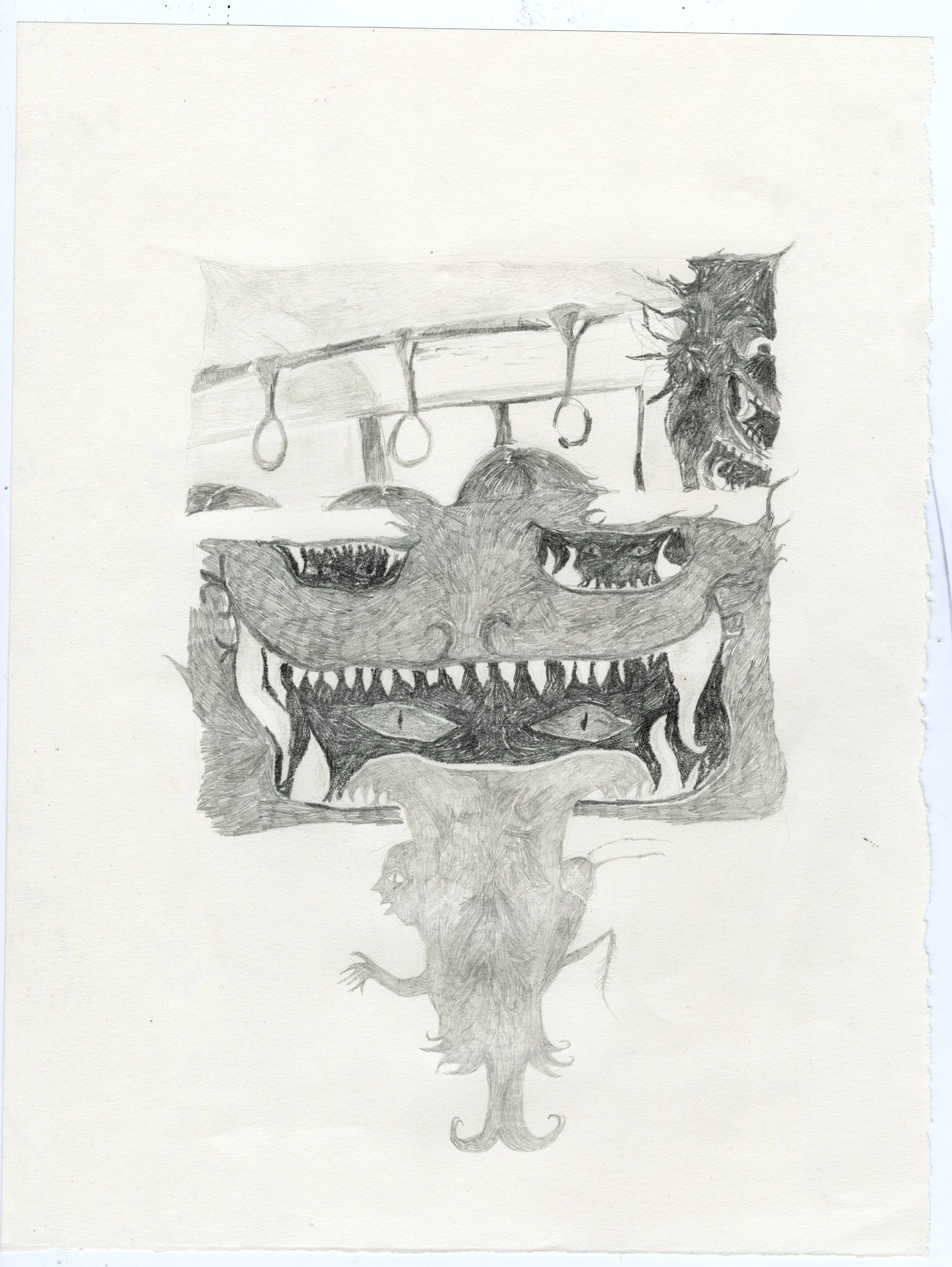
Illustration by Kiara Amartya
Sial!
(Trigger Warning:
This story unwraps around themes of
suicide, colonialism, fascism and gore.
Reader discretion is advised.)
Sial! was born once in a black moon (or month) when the abandonment of a prison, coincided with the suicide of a fascist.
I first met her as I was staring at a dried-up spot, not sure if it was spit or blood, on my journey, trapped by a dead station from the embassy to my workplace in the propaganda ministry. In the sea of people in the train, standing while sleeping out of exhaustion, Sial! [1] was chewing on the soul that had caused that dried spot. She saw me watching and offered me a piece of fresh flesh smelling of gas.
She said, “There are those who feed on evil. But I am a vulture, I do not kill. I love the taste of evil that has been made to feel the full pain inflicted by their deeds. It is the highest form of intimacy to feed on someone who knows themselves completely. How many people can say they know themselves in their fullest forms?”
The gas-smelling flesh did not cry nor scream from pain, though pain had consumed it completely. With each sinew that Sial! was tearing out of its body, it murmured a name, and with each name, worlds unraveled.
“It gives me great pleasure to feed on colonizers, fascists, rapists, corrupt politicians, murderers, enslavers, and all those who un-alive themselves in the process of un-aliving the other. I merely bring them back to Life, I take away their numbness, and let them feel everything – I flatten the realities of this earth, and pull away the curtains separating them from their sacrifice. The maggots eating away at prisoners’ wounds in the most cruel conditions, the mutilations inflicted by their bombs and their weapons, the starvations of the body and the soul made by their deeds and policies, the screams of our forests, our mountains, our soils. The entropy, the suffocation, the deprivation, the desperation of the dispossessed!
The countlessuncountable souls are dying fromof millions of cuts each.
I let them feel it. Every cut, every slice, every stone.”
“Does it not harm you?” I asked. “Even cockroaches are careful with the poisons they eat.”
“I did nothing,” she said. “I did not lift a finger. When their fleshes and souls felt the full meaning of their deeds, they did to themselves the kindest thing one could do to one who is experiencing unimaginable accumulated pain.
I am not interested in revenge. Because my body and soul digest bitterness into joy, I do all of this out of pure pleasure.”
She smiled at me, and I smiled back.
Like all beings, Sial! knows she will die. In her previous life, her name was Tumbal (Sacrifice). And like most beings, Sial! felt the need to be witnessed, so she asked me to write her story down.
*
When I was younger, back when my circumstances had been patient enough to let me dream, I wanted to write a story that would do honour to those people whose stories oftentimes don’t make it to history books.
Who, because of one reason or another, have been relegated to be forgotten, unconsciously or on purpose, in the corners of people’speoples’ minds, their freedom fights remembered only by the old Earth and the mortal ones who cared enough in Life to find something precious in their stories.
A story about the child who sat on their parent’s shoulders and cried out against the mass murders of other children. I did not know what the child had witnessed happen to others who looked like them, other children, whose fates had been segregated only by pure chance of having been born under another set of circumstances on this Earth. The child whom I met on the streets, small and passionate, crying in a rage against injustice that I had never witnessed in any child before, in a grief so deep that reminded me of what I had forgotten – that children instinctively remember their past lives much better than we do, and that their sensitivity to other people’s pain had not yet been gated by our self-imposed collective traumas of a segregated “us” and “them”. As I continued to followtail this child who was screaming against injustice, I made a promise to them and to all the other children they were crying out for, a promise that I am scared I won’t be able to keepfulfill.
And another story, a story about her: who came here to escape and to hide, to finally find her freedom and her self, or so she thought – yet there was something else very urgent about the murderous world, that she saw the mutilation happening to her people as if the Colonizers had cut and stolen parts of her too, and she desperately gave her breath to their suffocations, and then it all came rushing back to her, some she told me about and some she didn’t. We met in the streets again, in the rotting capital-corpse city of the Police-State. She was walking its teeth as if she owned the place, and not the other way round; as if all of it owed her something. I told her: I came to take back what’s mine, what’s ours. We understood each other with that, and I made her a promise that I would see to it that she lives a long, happy Life.
But now I’m remembering stories of the promises I failed to make to other people: for example, the people I grew up with, not even 200 meters apart from each other, separated by a Wall that kept growing year after year, first marking the segregation between their class and mine, and as the town grew to accommodate a class that was above both of us, a class that produced ghost towns traded not for Life but for investment. The Wall grew, and closed at 12 midnight until 6 in the morning, preventing anyone from traveling between them. I don’t know what happened to the friends with whom I grew up with, climbed the trash mountains, with and played football in the red dirt fields with, now having been swept away and swarmed over by new middle-class neighbourhood complexes equipped with their own security patrols, surveillance cameras, and automated gates.
So is our legacy.
When I was younger, I thought I had witnessed enough hope and resistance to write about until the end of my life. I believed that the apocalypse was knocking next door, but so was the Revolution.
But my circumstances grew impatient with me, and the lessons I’d learned accumulated into various chronic joint pains and emotional migraines of all flavors. History, was done with its 30-minute state-mandated break, had come back in full force, and was punishing people like me and people like me for daring to be hopeful, as well as those who tried theirour best to put theirour bodies on the line in the name of hope.
The Revolution had come in the middle of the night to knock on our door, yet none of us could come greet it. Our house had become hostile – the floors liquified and gave wayaway under our feet, and when we weren’t holding each other tight, we came for each other’s throats.
It was during the times of “peace” and “independence” that human rights lawyers were killed with arsenic in airplanes, that children were committing suicide because they couldn’t afford to buy schoolbooks, that police personnel’s houses grew larger and heavier with empty rooms and full-fledged furniture in the same speed that prisons grew overstuffed with bright-kind people, desperate thieves who never took more than a couple of their neighbor’s chickens to feed their starving family and who couldn’t afford to pay bribes. It was during times of “reform” that authoritarianism and militarization crept theirits way into our collective imaginations, tainting them with the urgency of compliance in the name of survival.
The wound never healed;, it merely mutated.
I grew resentful of those who kept crying out for freedom, the ones who were willing to risk it all for a life of total liberation and dignity. They said they were fighting for me too, but the Police-State and human nature have all kinds of ways to turn us against each other. Collective punishment through regime changes, suffocating laws and policies, and a free-for-all brutality was one thing; it was another thing to be forced to pay for the betrayals of dear friends and comrades who did what they had to do under monstrous circumstances.
I couldn’t blame them. Is that why I became one of them?
*
Since our first meeting onin the train, Sial! had shownshowed up several times, each time opening our conversations with elaborate tales of her meals.
One time, I met her in a supermarket, between the aisles filled with colorful snacks of endless varieties, yet each containing almost exact ingredients.
She was wrestling someone to the ground, using her elbows to dig into her victim’s spine before she tore it out with her dull teeth. “They used to be sharp, but I ground them down into blunt objects,” she cackled at me between her ravenous, bloody bites. “They cause more pain that way, and it snaps my meals out of their self-pity and into full reality.” Her ‘meal’ was still alive and screaming, but shockingly, not from the pain of being eaten alive – but rather from the pain that had come home to roost.
“It’s just a drink! Just a soda drink! I did nothing wrong! I did not bomb those innocent children into pieces, I did not pollute their waters and lands, I did not normalize their occupations! All I did was—… all I did,… was make the contracts! Aaaaaaaarrrrggghhhh! If it hadn’t been me, it would have been someone else!”
“Denial is a powerful drug,” Sial! whispered softly. “And now you don’t have it at your disposal anymore. Would you like me to release you from your pain, and the pain you have caused countless others? Let me tell you their names…”
And so, between her chewings, she started to recite their names – each one of them dispossessed in their own ways. And the contract-maker, beaten, bloody, and missing some parts of his spine at that point, also started to recite their names.… a A horror of a lullaby, yet I couldn’t take my eyes ornor ears off this duet. With each name he recited, he tore off a sinew from his own body and presented it to Sial! as if to ask for forgiveness from the cannibalistic angel of death.
The only difference being that Sial! was never an angel, nor a god, nor the fact that Sial! was never an angel, nor a god, an Iblis, nor a Djinn – like you, like me, she was merely a Tumbal [2].
I have never seen such levels of terror with my own eyes, and yet, perhaps I have.
Like Sial! said, "Denial is a powerful drug.”
*
This time, I was sitting in the embassy's waiting room, organizing my personal documents so I could apply to extend my work permit at the immigration office later. I had spent the past months begging the sentinels at the propaganda ministry for a single crucial document to complete this exhausting process. During this time, a complete background check was the least of my hurdles. Bending over for survival was my breakfast, lunch, and dinner.
Still, I was privileged. Things could be a lot worse. Working for the propaganda ministry of a foreign country that was friendly with mine (if I could still call it ‘my’ country at this point, for all my lack of agency in that place) afforded me certain protections than people of my age and status back ‘home’.
The waiting room was simple but alluring. The sofas were large and comfortable, and tropical trees grew in large pots under artificial grow lights. The curtains were white- and gold-colored, filtering the winter sun into something that almost threw me back to the Kath al-Istiwa [3]. The people who were waiting with me were applying for tourist visas. They were excited aboutfor the sun, sand, and the currency exchange rate. Nothing in this embassy’s waiting room betrayed the mass demonstrations that were currently taking part in all major cities of my ‘home’ country – no trace of expired tear gas that could cause sickness for weeks, of fresh blood mixed with dried blood mixed with sweat, no roar of the angry, desperate, starving masses who have so little left to be dispossessed of.
Above the monitor where our waiting numbers were displayed, a three-meter-by-twothree-meter by two oil painting with an elaborately carvedelaborately-carved mahogany frame depicted a serene scene of sweeping rice paddies, mystical mountain ranges and trees, and five farmers bending over to work the fields.
The painter was highly skilled; each grain on each stalk of the rice paddy was meticulously painted in shades of yellow, green, and orange. Each leaf on the bamboo and kapok trees surrounding the rice fields waswere more real than real, capturing details my vision could not normally discern as I roamed my gazerealer than real, capturing details my vision could notsuch a detail that would normally be impossible for my vision to dissect as Ithe time when I roamed my eyes over the trees that I had grown up with. The lush indigo mountains, snuggled by wisps of clouds, were lined in soft amber – was it the promise of sunrise, or of gold waiting to be mined?
The painting reminded me of an image that all schoolkids where I come from learn to draw. It is part of our official curriculum. Two hills with a sun in betweeninbetween, v-shaped birds flying overhead, a swirling path or a river flowing down (depending on the color), houses, and v-shaped crops indicating rice fields. A leftover artistic tradition from the colonial era, encouraged by the colonial governments, when painters drew of beautiful rice fields, rainforests, mountains, and farmers tilling the land, as an image widely disseminated by the colonial governments – filled with exotic natural beauty (and resources), beautiful women (available), and hard workers (subjugated). This beautiful official image hid the violence systematically perpetrated by the colonial governments and, later, our own government. Paintings of rice fields remain widely popular and a way for art school graduates and painters to earnare still widely popular and a way for art school graduates and painters to make money.
Though ownership has changed hands, the colonial relationshiprelation has stayed more or less the same throughout the centuries.
“She was absolutely delicious, though a bit nickel-y,” came a voice from behind my eyes. “But honestly, I thought she would have tasted worse – seperti debu tambang yang bertaburan di nasi, dan ketika kau memakannya, tak ada rasa apa pun yang tercicip di lidah, karena mulutmu pun sudah setengah debu tambang. I thought she would have tasted like the dust of mining sites that had settled in rice, and when you’d eat it, you wouldn’t have tasted anything because your mouth’s already half mining dust anyway.
I’ve eaten people like that. They’re not even the most vile of murderers. The worst ones try to hide the smell of rotting blood coming out of their pores with perfumes and baths, with air conditioning and flowers. The paddy fields they own are built on forest fires and ecological death, and their rice is washed and prepared by those who despise them, and passes through the mouths of poison-testers before it arrives in their mouths. Rice washed in spite, spit, and duty.”
“Your descriptions of food are so detailed, sometimes I almost feel hungry,” I told her.
I could almost hear her smile, and without invitation, I felt her move from behind my eyeballs into the painting. The nonchalant, hardworking farmers started to sweat. It stained their armpits and dripped down from their foreheads. A farmer inside the painting pans towards me, and for the first time, I saw a face. I saw that her eyes were just like mine, clouded over by the mask of duty. The obligation towards the Profit-Police State says:, "If it weren’t you, it would have been someone else." What choice does either of us have? It wouldn’t have made a difference, so the best you can do is to keep your head down, play the game, and hope the meager privileges you reap can protect you until it’s all over, and to hope that the end does not come too painfully and does not drag out for too long.
“Bitter!” Sial! smiled at me. She had emerged from between the grains of paddy. The oil colours rippled over and reconfigured as they made space for her and for the farmer’s grief.
“If I’d wanted to stay dead, I wouldn’t have come back to Life,” Sial! whispered through the tongues of paddies. “And my dear sister here, whom I’ve known in all my Lives, agrees with me.” Her whisper rippled over the entire painting, and a cool breeze swayed the rice fields, the bamboo rimpang, and the kapok trees. Slowly, all the farmers sat down, except for the one who was facing me. She stayed standing, and whispered, her voice and Sial!’s voice the sameone and the same:
“Each grain of rice that enters your mouth has passed through my hands, has been washed by my tears and my sweat, by my grief and my hopes. Perhaps you never knew my name, and you never saw my face. Many wouldThere are many who would like to tell my story only as far as it furthers their narratives. Tapi aku mengenalmu secara intim ketika keringatku menyentuh isi mulutmu. Kami sudah lama, sangat lama, saling mengenal. But I know you intimately when my sweat touches the inside of your mouth. We have known each other for a very, very long time.”
My hands, armpits, and eyeballs started to grow wet with sweat, the sweat that I had kept inside for so long for fear that I might dissolve into salt. Do you know what happens to people who become nothing but salt? They occupy kitchens and dining settings all throughout the world, and become essential tofor preservation processes necessary to withstand times of scarcity. Yet, no one remembered their names ornor who they were, just. Just like the sweaty sister farmer and her sweaty grains of rice.
Her voice rang through the chambers of my mind, shaking the dust of resignation that had gathered between the cracks of closed doors of my imagination, at once kind yet firm, unforgiving, igniting the coals of what little was left of my disobedience: “As long as there has been oppression, there has also always been resistance against oppression.”
A man in an impeccably ironed shirt was shouting my waiting number. The impatient voice was coming closer, but I could barely hear him over the sounds of the walls inside my own mind collapsing, and in its place, rhizomatic plants of all kinds multiplying and taking over the ruins of my own defeat.
“Like salt, like earth, like roots.”
Sial! and the sister farmer’s voice rang through the rhizomes.
Jika masih ada kehidupanKehidupan di dalam dirimu yang bisa berkeringat, mungkin masih ada harapan untukmu. Percayalah ini: Jadilah seperti rimpang – berlipat gandalah dan menyebarlah kemana-mana atas nama Kehidupan.[4]
If there is still Life inside you that canhas the ability to sweat, then maybe there remains some hope for you. Believe this:Be like the rhizomes – multiply, and spread everywhere in the name of Life.
[From the journals of Tuturhilir, Vol. XX, 20XX] [5]
*
1 ‘Sial’ in the Indonesian language translates to ‘bad luck’ or the expletive ‘damn!’
2 ‘Tumbal’ traditionally means a sacrifice for black magic purposes, and in contemporary Indonesian language can also be interpreted politically, i.e., a political sacrifice
3 ‘Khat al-Istiwa’ is a loanword from Arabic, which mutated into ‘Khatulistiwa’ in Indonesian, which means ‘the equator.’
4 In the Indonesian territories, ‘rimpang’ or rhizomes became a popular symbol for underground, decentralized, and collective resistance, as rhizomatic plants like bamboo are known to grow and spread incredibly fast, expanding beyond the central growth point. Other rhizomatic plants like ginger, curcuma, and galangal (staples in cooking throughout the archipelago) are prized for their underground rootsroots that grow underground.
5 ‘Tutur’ means ‘to narrate’, and ‘hilir’ is the edge of a river, or the location where the river meets the sea
*
‘Sial!’ is my short story originally published in the anthology zine ‘Unions of Spirits: and their Tales of Shadows, Imaginations, and Sorceries’ (March 2026), edited & initiated by Rizqita Naherta, featuring contributions by Dewi Sofia, Jasmine Grace Wenzel, Kiara Amartya, Josefina Contin Zapata, & Raras Umaratih (me). Project funded by the Roodkapje Rotterdam Project Space.
